Table of contents
- 01Common flat roof problems
- 02When a repair is enough
- 03Signs replacement is needed
- 04Flat roof material options
- 05Lifespan and cost comparison
- 06Getting a flat roof quote
Flat roofs have come a long way. The old image of a felt roof that cracks after a few hard winters and leaks every spring is increasingly outdated — modern flat roofing materials like EPDM rubber and GRP fibreglass are tough, long-lasting and properly weatherproof. But plenty of older flat roofs are still out there, and if yours is starting to give you trouble, the question is the same: do you repair it, or is it time to replace it?
This guide helps you decide. We cover the most common flat roof problems, when a repair is sufficient, when replacement is the better spend, and the material options available if you do go for a new flat roof. We fit flat roofs across Worcester, Malvern, Droitwich, Pershore, Evesham and the wider Worcestershire area.
Common Flat Roof Problems
Flat roofs fail in different ways to pitched roofs. Because they do not have the natural water-shedding advantage of a slope, water sits on them longer and the membrane does more of the waterproofing work. Here are the problems we see most often:
Blistering and Bubbling
Blisters — raised bubbles in the felt or membrane — form when moisture or air gets trapped between layers. They are common on older felt roofs. Small blisters might not leak immediately, but they weaken the membrane and eventually split open. If your flat roof has extensive blistering, the membrane is failing across its area, not just in one spot.
Splits, Tears and Cracks
Felt roofs crack as the bitumen ages and becomes brittle. UV exposure, temperature cycles and frost all contribute. A single split can often be patched, but if cracks are appearing across the roof, the material has reached the end of its life. EPDM and GRP are far more resistant to cracking, which is why they last longer.
Ponding Water
Flat roofs should drain, even if the slope is gentle. If water pools on the roof and does not drain away within 48 hours of rain, you have a ponding problem. This can be caused by a sag in the deck, blocked outlets, or an inadequately pitched roof. Ponding water puts constant pressure on the membrane and accelerates degradation. It also adds weight — a square metre of water 25mm deep weighs 25kg.
Felt Degradation
Older torch-on felt roofs have a lifespan of 15 to 25 years. As the felt ages, it loses flexibility, the surface chippings wash away, and the bitumen dries out and cracks. If your felt roof is over 20 years old and showing any of the above signs, it is living on borrowed time.
When a Repair Is Enough
Not every flat roof problem means replacement. A repair is the right call when:
- The roof is relatively young. An EPDM or GRP roof under 15 years old with a localised split or puncture can usually be patched successfully. The surrounding membrane is still sound.
- The damage is in one area. A single split, a puncture from a falling branch, or a leak around a single detail (a pipe flash, an edge trim) can be repaired without replacing the whole roof.
- The problem is the detailing, not the membrane. If the membrane is fine but water is getting in at an edge, a corner, or a flashing, repairing that detail solves the problem.
- Ponding is localised. If water ponds in one small dip, it can sometimes be resolved by improving the fall or adding a drainage channel, without replacing the whole roof.
A good repair on a sound flat roof membrane can last years. The key is that the surrounding material is still in good condition — a patch on perished felt will not last long because the felt around it will fail next.
Signs Replacement Is Needed
Replacement becomes the better call when the membrane is failing across its area, not just in one spot. Here are the signs that patching is no longer the answer:
- Multiple leaks in different areas. If the roof leaks in more than one place, the membrane is failing broadly.
- Widespread cracking or blistering. If splits and blisters are appearing across the roof, the material has degraded past the point of repair.
- The roof is over 20 years old (felt). Torch-on felt has a 15 to 25 year lifespan. If yours is in that range and giving problems, a full replacement is better value than repeated patches.
- The deck is sagging or rotten. If the timber deck underneath the membrane is soft, rotten or sagging, the membrane has to come off to repair the deck. You would not put an old membrane back on a repaired deck.
- Repairs keep failing. If you have patched the roof two or three times and it keeps leaking in new places, the membrane is done.
For help weighing up the decision in more detail, see our guide on roof repair vs replacement, which covers the cost comparison over time.
Flat Roof Material Options
If you are replacing your flat roof, you have three main material options. Each has different characteristics, lifespans and price points:
EPDM Rubber Roofing
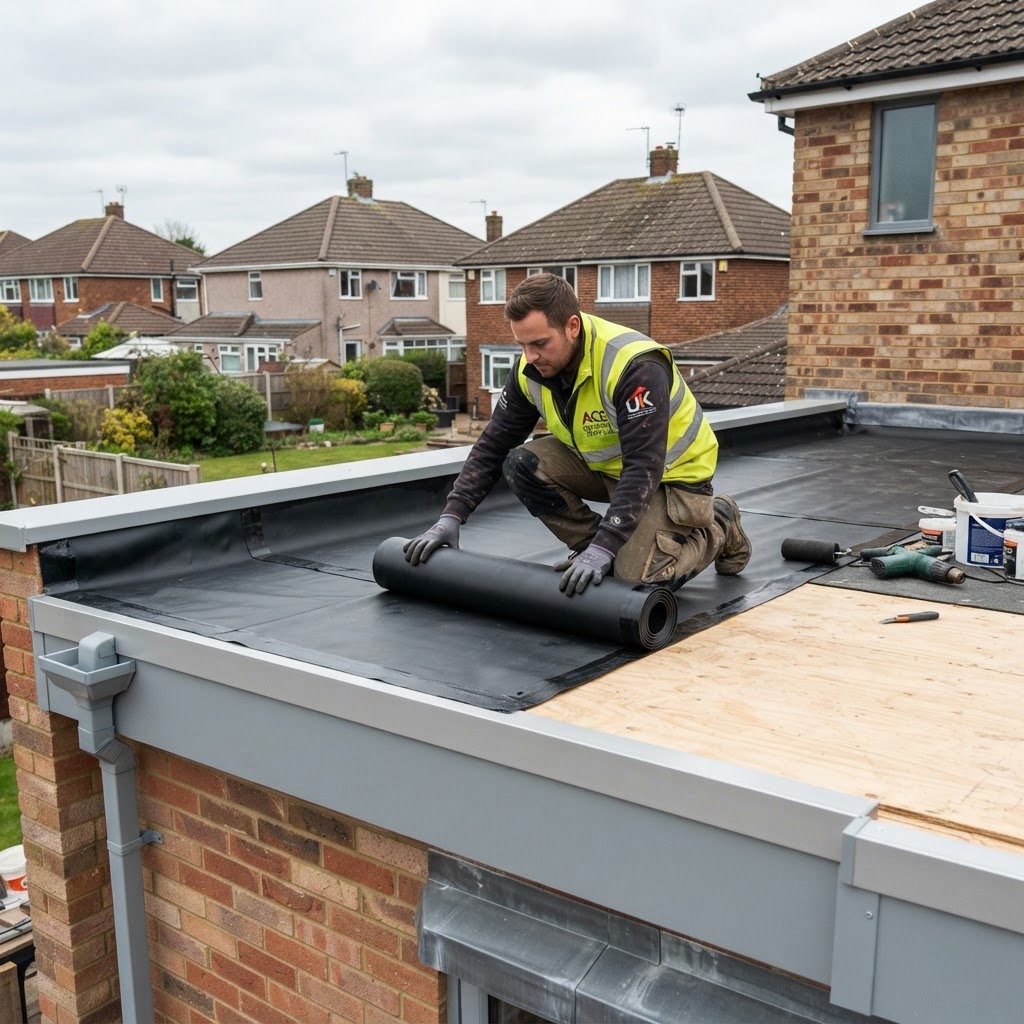
EPDM (ethylene propylene diene monomer) is a synthetic rubber membrane that comes in large, seamless sheets. It is flexible, UV-stable, and resistant to ozone and temperature extremes. A properly installed EPDM roof can last 30 to 50 years. It is our recommended flat roofing material for most domestic situations — extensions, garages, dormers and small commercial roofs. See our EPDM rubber roofing page and our EPDM explainer guide for more detail.
GRP Fibreglass Roofing
GRP (glass reinforced plastic) is a fibreglass system laid in situ — a resin and fibreglass mat are applied wet and cure to form a single, seamless, rigid surface. GRP is extremely tough and completely seamless, making it excellent for roofs with complex shapes or multiple details. Lifespan is 25 to 35 years. It is slightly more expensive than EPDM but offers a harder-wearing surface. See our GRP fibreglass roofing page for more.
Torch-On Felt
Traditional torch-on felt (modified bitumen) is applied in two or three layers with a torch, bonding the layers together. It is the cheapest option and still widely used, but it has the shortest lifespan — 15 to 25 years. We typically recommend EPDM or GRP for new flat roofs because they last significantly longer with less maintenance, but felt remains a valid budget option. See our felt roofing page for more.
Lifespan and Cost Comparison
Here is how the three main flat roof materials compare on lifespan and typical cost for a standard domestic flat roof (around 20 to 30 square metres):
- Torch-on felt: 15 to 25 year lifespan. Typical cost £1,500 to £2,500. Cheapest upfront, shortest lifespan.
- EPDM rubber: 30 to 50 year lifespan. Typical cost £2,000 to £3,500. Best value over the long term.
- GRP fibreglass: 25 to 35 year lifespan. Typical cost £2,500 to £4,000. toughest surface, excellent for complex roofs.
Over a 40-year period, felt would need replacing at least once and possibly twice, while EPDM would likely still be going strong. The lifetime cost of EPDM is usually lower than felt, even though the upfront cost is higher.
Getting a Flat Roof Quote
A flat roof quote should be based on an inspection, not a phone call. The roofer needs to see the roof, check the condition of the deck underneath (which may need repairing), measure the area, and identify any detailing challenges — edges, trims, pipe flashes, skylights. The quote should specify the material being used, the thickness or grade, the number of layers (for felt), and what preparation work is included.
If a quote just says "new flat roof, £X" with no material specified, ask for clarification. The difference between a felt roof and an EPDM roof is significant — in both cost and lifespan. You need to know what you are getting.
We provide free flat roof surveys across Worcester and Worcestershire. We will tell you honestly whether a repair will do or whether replacement is the better call, and we will give you a written, itemised quote for the work. Get in touch or call 01905 349450.
Summary
If your flat roof has a localised problem and the membrane is otherwise sound, a repair is the right call. But if the roof is leaking in multiple places, the membrane is cracked or blistered across its area, the deck is sagging, or the roof is over 20 years old (for felt), replacement is better value than repeated patches. For a replacement, EPDM rubber is our recommended material for most domestic roofs — it lasts 30 to 50 years and offers the best long-term value. If you are unsure, a free inspection will tell you which way to go.
Related resources
FAQ
Frequently asked questions
Should I repair or replace my flat roof?+
If the damage is localised (a single split, puncture or flashing failure) and the membrane is otherwise sound, a repair is the right call. If the roof leaks in multiple places, the membrane is cracked or blistered across its area, or it is over 20 years old (for felt), replacement is better value than repeated patches.
How do I know if my flat roof needs replacing?+
Signs that replacement is needed include multiple leaks in different areas, widespread cracking or blistering, a sagging or rotten deck, ponding water that does not drain, and repairs that keep failing. A roof inspection will confirm whether the membrane has reached the end of its life.
What flat roof materials are available?+
The three main options are EPDM rubber (30 to 50 year lifespan), GRP fibreglass (25 to 35 years), and torch-on felt (15 to 25 years). EPDM is our recommended material for most domestic flat roofs due to its long lifespan and excellent value over time.
How long do flat roofs last?+
It depends on the material: EPDM rubber lasts 30 to 50 years, GRP fibreglass 25 to 35 years, and torch-on felt 15 to 25 years. A properly installed EPDM or GRP roof significantly outlasts a traditional felt roof.
What does flat roof replacement cost in Worcester?+
For a typical domestic flat roof (20 to 30 square metres), felt costs £1,500 to £2,500, EPDM costs £2,000 to £3,500, and GRP costs £2,500 to £4,000. The exact price depends on size, access, the condition of the deck, and any detailing work required.
Can I put a new flat roof over the old one?+
Overlaying is sometimes possible if the existing deck is sound and dry, but it is not recommended if the old membrane is failing across its area or the deck is damaged. A proper strip-and-replace lets the roofer inspect and repair the deck, which gives a longer-lasting result.
Flat roof giving you trouble? Get a free Worcester flat roof survey.
Call Sure Roofing Worcester for a free, no-obligation quote. Same-day response across Worcestershire.