Table of contents
- 01What EPDM roofing is
- 02How EPDM is installed
- 03EPDM vs felt vs GRP
- 04Lifespan and durability
- 05EPDM cost in Worcester
- 06Maintenance and repairs
If you have a flat roof — on a garage, an extension, a dormer or a balcony — you have probably heard of EPDM. It has become the go-to flat roofing material for domestic properties across the UK, and for good reason. But what exactly is EPDM, how does it work, and is it the right choice for your flat roof? This guide explains everything a homeowner needs to know about EPDM rubber roofing in plain English.
We have been fitting EPDM roofs across Worcester, Malvern, Droitwich, Pershore, Evesham and the wider county for years, and it is the material we recommend for most domestic flat roof situations. Here is why.
What EPDM Roofing Is
EPDM stands for ethylene propylene diene monomer — a synthetic rubber membrane developed for roofing and other waterproofing applications. It is supplied in large sheets, typically 1.2mm thick, that are bonded directly to the roof deck. The key advantage of EPDM over traditional felt is that it comes in sheets large enough to cover most domestic flat roofs in a single piece — no seams, no joints, no weak points where water can get in.
EPDM is not a new material. It has been used in commercial roofing in the US and Europe for over 50 years, with many of those early installations still performing today. Its track record is well-established — this is not an experimental product. The material is UV-stable (it does not degrade in sunlight), ozone-resistant, and flexible across a wide temperature range (from -40°C to +120°C). It does not crack, become brittle or blister in the way that aged felt does.
For domestic flat roofs — typically 10 to 50 square metres — EPDM is usually supplied as a single seamless sheet that covers the entire roof. Larger roofs may require a joint, but these are sealed with specialist adhesives and tape that are as strong as the membrane itself. See our EPDM rubber roofing page for our installation service.
How EPDM Is Installed
A proper EPDM installation is a methodical process. The membrane itself is only as good as the surface it is bonded to and the detailing at the edges. Here is how a typical EPDM flat roof is fitted:
Preparation
The existing roof covering is stripped off to expose the timber deck underneath. The deck is inspected for rot, damage and soundness — any rotten timbers are replaced, and loose boards are fixed down. The deck must be clean, dry and smooth before the membrane goes on, because any imperfection underneath will telegraph through and potentially cause problems. For new builds or replacements, a timber deck (usually OSB3 or ply) is fitted to provide a solid substrate.
Membrane Application
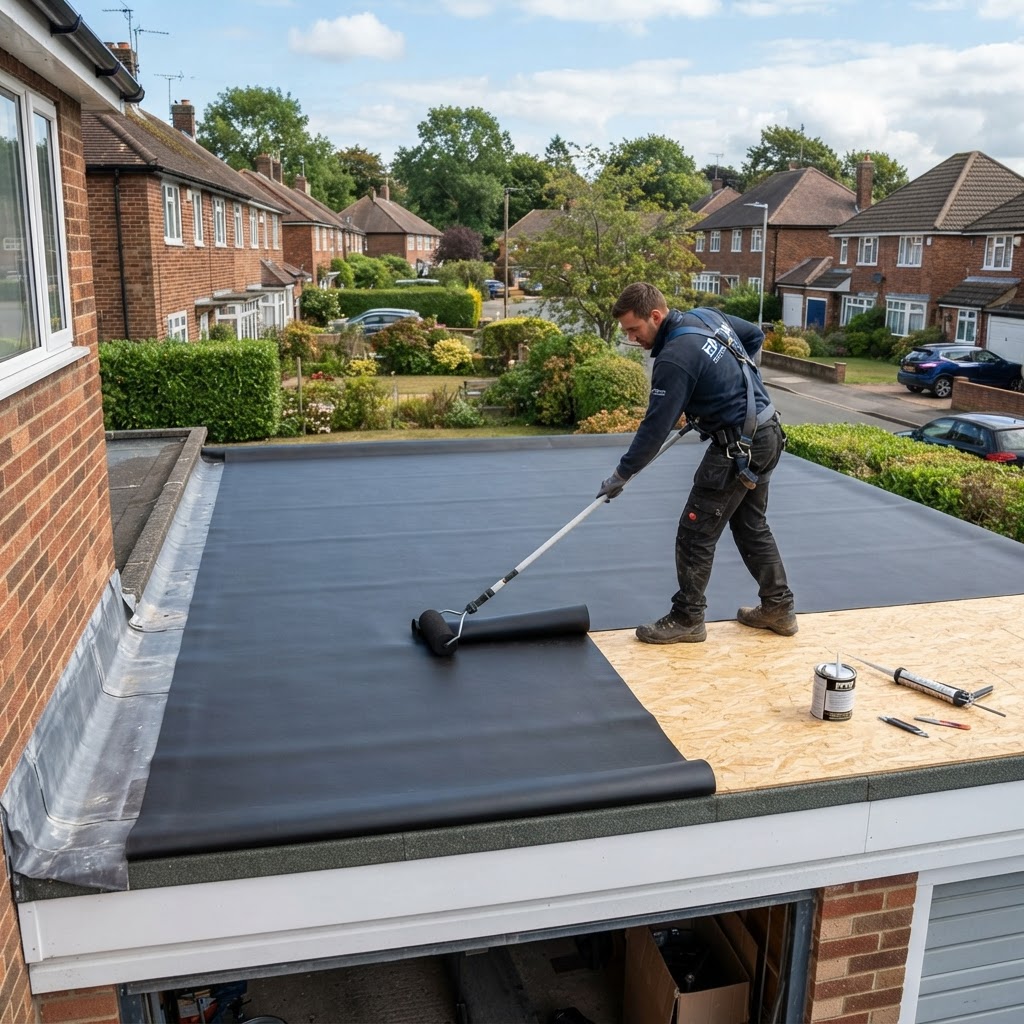
The EPDM membrane is cut to size with enough overhang to dress down over the edges. A specialist water-based adhesive is applied to the deck, and the membrane is rolled out onto it, smoothed down to remove any air bubbles, and bonded edge to edge. Because the adhesive is water-based, there are no fumes or solvents — unlike torch-on felt, which requires a gas torch and hot bitumen. This makes EPDM safer to install and suitable for roofs where torch-on felt would be a fire risk.
Detailing and Trims
The edges of the membrane are dressed over the roof edge and secured with metal trims. Upstands — where the roof meets a wall or parapet — are sealed with termination bars and EPDM flashing tape. Pipe penetrations, skylights and corners are sealed with purpose-made EPDM accessories. This detailing is where the quality of the installation shows — a good roofer takes time on every joint and upstand to ensure a fully weathertight finish. Poor detailing is the most common cause of EPDM roof failures, which is why choosing a competent installer matters. See our guide on how to choose a roofer.
EPDM vs Felt vs GRP
EPDM is one of three main flat roofing materials. Each has its strengths, and the best choice depends on the roof, the budget and the circumstances. Here is how they compare:
- EPDM rubber — seamless, flexible, UV-stable, 30 to 50 year lifespan. No flames or fumes during installation. Best all-round choice for most domestic flat roofs. Typical cost for a 20 to 30 m² roof: £2,000 to £3,500.
- GRP fibreglass — seamless, rigid, extremely tough, 25 to 35 year lifespan. Applied as a wet layup (resin and fibreglass mat) that cures to a hard shell. Excellent for roofs with complex shapes or foot traffic. Slightly more expensive than EPDM. See our GRP fibreglass roofing page.
- Torch-on felt — traditional, cheapest, 15 to 25 year lifespan. Applied with a gas torch and hot bitumen in two or three layers. Prone to cracking and blistering as it ages. Still a valid budget option but the shortest lifespan of the three. See our felt roofing page.
For most domestic flat roofs — garages, extensions, dormers — EPDM is our recommendation. It offers the best balance of lifespan, cost and performance. GRP is the better choice for roofs with complex shapes or where the roof surface will be walked on. Felt is a budget option where cost is the primary concern. See our flat roof repair or replacement guide for help deciding whether to replace and which material to choose.
Lifespan and Durability
A properly installed EPDM roof has an expected lifespan of 30 to 50 years. The membrane itself does not degrade in UV light, does not become brittle in cold, and does not soften in heat. It is flexible enough to accommodate the natural movement of the timber deck underneath — something that rigid materials like felt struggle with, which is why felt cracks over time.
EPDM is also resistant to standing water. While no flat roof should pond water (it indicates a drainage problem that should be fixed), EPDM will tolerate temporary ponding far better than felt, which degrades when water sits on it. This resilience is one reason EPDM outlasts felt so significantly.
The most common cause of EPDM failure is not the membrane itself but the detailing — edges, upstands, joints and penetrations. A well-installed EPDM roof with proper detailing will last decades. A poorly installed one with sloppy detailing may leak at the edges within a few years. This is why the installer matters as much as the material.
EPDM Cost in Worcester
For a typical domestic flat roof in Worcester — a garage or extension of around 20 to 30 square metres — an EPDM replacement typically costs £2,000 to £3,500. The exact price depends on:
- The size and shape of the roof (complex shapes with multiple upstands and penetrations cost more)
- The condition of the timber deck (rotten timbers need replacing)
- Access (a roof that needs scaffolding or is hard to reach costs more)
- Detailing requirements (skylights, pipes, multiple edges)
- Whether the old roof needs stripping (it almost always does)
For comparison, a felt roof on the same property would cost £1,500 to £2,500, and a GRP roof £2,500 to £4,000. While EPDM costs more upfront than felt, its 30 to 50 year lifespan versus felt's 15 to 25 years makes it better value over time — you would need to replace a felt roof at least once in the lifespan of an EPDM roof. See our new roof cost guide for broader roofing cost guidance.
Maintenance and Repairs
EPDM roofs are very low maintenance. There is no surface chipping to replace (as with felt), no regular recoating required, and no seams to inspect. An annual visual check — clearing debris, checking that outlets are not blocked, and looking for any physical damage — is usually all that is needed.
If the membrane is punctured (for example, by a falling branch or a dropped tool), repairs are straightforward. EPDM repair tape and patches are applied to clean, dry membrane and form a permanent, weathertight seal. A small puncture repair takes minutes and costs very little — far simpler than repairing a split in felt.
For ongoing maintenance advice and periodic inspections, see our roof maintenance service. And if you are unsure whether your existing flat roof needs repairing or replacing, see our flat roof repair or replacement guide.
Summary
EPDM rubber roofing is a synthetic rubber membrane that comes in large, seamless sheets and is bonded directly to the roof deck. It is UV-stable, flexible, and resistant to standing water, with a lifespan of 30 to 50 years — significantly longer than traditional felt. For most domestic flat roofs in Worcester and Worcestershire, EPDM is our recommended material because it offers the best balance of lifespan, cost and performance. If you are considering a flat roof replacement, get in touch or call 01905 349450 for a free survey and written quote.
Related resources
FAQ
Frequently asked questions
What is EPDM roofing?+
EPDM (ethylene propylene diene monomer) is a synthetic rubber membrane used for flat roofing. It is supplied in large, seamless sheets — typically 1.2mm thick — that are bonded directly to the roof deck. It is UV-stable, flexible, and resistant to ozone and temperature extremes, with a 30 to 50 year lifespan.
How long does EPDM roofing last?+
A properly installed EPDM roof lasts 30 to 50 years. The membrane itself does not degrade in UV light, does not become brittle in cold, and does not soften in heat. It is significantly longer-lasting than traditional felt, which lasts 15 to 25 years.
Is EPDM better than felt?+
For most domestic flat roofs, yes. EPDM lasts 30 to 50 years versus felt's 15 to 25 years, comes in seamless sheets (felt has joints), does not crack or blister as it ages, and is installed without flames or fumes. EPDM costs more upfront but is better value over the long term.
How much does EPDM roofing cost in Worcester?+
For a typical domestic flat roof (20 to 30 square metres), an EPDM replacement costs £2,000 to £3,500. The exact price depends on the roof size and shape, the condition of the timber deck, access, and detailing requirements such as skylights and pipe penetrations.
Can EPDM roofing be repaired?+
Yes. EPDM is straightforward to repair — punctures and small splits are patched with EPDM repair tape or patches that form a permanent, weathertight seal. A small repair takes minutes and costs very little, far simpler than repairing a split in felt.
How is EPDM roofing installed?+
The old covering is stripped to expose the timber deck, which is inspected and repaired. A water-based adhesive is applied to the deck and the EPDM membrane is rolled out, smoothed down and bonded edge to edge. Edges are dressed over with metal trims, and upstands and penetrations are sealed with EPDM flashing tape and accessories.
Considering EPDM for your flat roof? Get a free Worcester quote.
Call Sure Roofing Worcester for a free, no-obligation quote. Same-day response across Worcestershire.