Table of contents
- 01Assessing your roof
- 02When repair makes sense
- 03When replacement wins
- 0410-year cost comparison
- 05Lifespan differences
- 06Deciding with a roofer
If your roof has started giving you trouble, you face a decision that every homeowner dreads: do you patch it up again, or is it finally time to bite the bullet and have it replaced? It is not always an easy call. A repair is cheaper today, but it might be throwing good money after a bad roof. A replacement is a bigger spend, but it could save you years of stress, recurring leaks and escalating repair bills.
This guide walks through how to assess your roof honestly, when a repair makes sense and when it does not, and how to weigh up the long-term costs so you can make the right decision for your home and your budget. We have been helping homeowners across Worcester, Malvern, Droitwich and the wider county make this call for over 30 years — and we do not always recommend replacement.
How to Assess Your Roof's Condition
The starting point for any repair-or-replace decision is a proper assessment. You cannot make this call by looking at a photo or guessing from the ground. A roofer needs to get up there, check the tiles, the underlay, the timber structure and the detail work — and also look inside your loft.
What a Roofer Looks For
When we inspect a roof, we are looking at several things: the condition of the tiles or slates (are they cracked, spalled or slipping?), the state of the nail fixings (are nails corroding and failing?), the underlay (is it perished or torn?), the flashings and leadwork (are they cracked or lifting?), the ridge and hip lines (is the mortar cracked or missing?), and the timber structure underneath (is there any rot or sagging?).
Each of these tells us something different. A few cracked tiles is a localised problem. Nail failure across the whole roof is a systemic problem that means the roof is reaching the end of its life. A proper inspection distinguishes between the two.
Inside the Loft
The loft tells you what the outside cannot. Daylight coming through the underlay means gaps. Water stains on the timbers or felt mean leaks have been happening, even if you have not seen them in the rooms below. Soft or spongy timbers when pressed mean rot. If the loft shows widespread problems, the roof above is likely failing across its area, not just in one spot.
When a Repair Makes Sense
Repairs are the right call when the roof is fundamentally sound but has developed a localised problem. Here are the situations where a repair is almost always the better choice:
- Isolated tile damage. A few tiles cracked by impact (a falling branch, for example) or slipped by a storm. The rest of the roof is firmly fixed and in good condition.
- A single localised leak. The leak is traceable to one spot — a cracked flashing, a slipped tile above a specific room, a damaged valley section. The rest of the roof is dry and sound.
- Chimney or flashing failure. The roof covering itself is fine, but water is getting in around a chimney stack or abutment wall. Chimney repointing or flashing replacement solves it without touching the rest of the roof.
- The roof is relatively young. If your roof is only 15 to 20 years old and the tiles are good quality, a repair is sensible. The roof should have decades of life left in it.
- Budget constraints. If you genuinely cannot afford a replacement right now, a well-executed repair can buy you time — but you should plan for the replacement rather than pretending the problem has gone away.
When Replacement Is the Better Spend
Replacement becomes the better call when the problems are widespread or systemic, not localised. Here are the signs that patching is no longer the answer:
- Repeated tile slippage. If tiles keep slipping in different areas, the nail fixings are failing across the roof. This is a whole-roof problem, not a local one.
- Widespread cracking or spalling. If tiles are cracking across multiple sections, the material itself is degrading. This typically happens as concrete tiles age past 40 to 50 years.
- The underlay is perished. Old bitumen felt tears and perishes over time. If the underlay is failing, water gets through even if the tiles look fine from outside. Replacing the underlay means stripping the roof, so a full re-roof becomes the logical step.
- Multiple leaks in different areas. One leak is a local problem. Leaks in several places mean the roof is failing across its area.
- Timber rot in the structure. If the roof timbers are rotting, the roof needs stripping so the timbers can be repaired or replaced — and you would not put old tiles back on a repaired structure.
- The roof is at or past its lifespan. Different materials age differently — see our guide on how long a roof lasts. If your roof covering has reached the end of its expected life, replacement is the sensible plan.
If several of these apply, a roof replacement is almost always cheaper in the long run than repeated repairs. Read our 10 signs you need a new roof guide for a more detailed checklist.
Cost Comparison Over 10 Years
The real cost of a roof is not just the bill today — it is the total spend over the years. Let us look at two scenarios for a typical Worcester semi-detached house with a roof that is starting to show its age.
The Repair Path
You opt for repairs each time a problem appears. Over 10 years, you might spend: £350 replacing slipped tiles (year 1), £500 fixing a valley leak (year 3), £600 on chimney flashing (year 5), £400 on more slipped tiles (year 7), £800 on a larger leak repair (year 9). That is roughly £2,650 in repairs — and the roof is still failing, still aging, and still needing more work. Eventually, you replace it anyway.
The Replacement Path
You replace the roof now. A concrete tile re-roof on a typical semi costs £5,500 to £8,000 (see our new roof cost guide). You get a sound, guaranteed roof that should need no significant repairs for 20 to 30 years. Over the same 10-year period, your total spend is the replacement cost — and you have peace of mind, no leaks, no recurring call-out fees, and no damage to your ceilings and decorations.
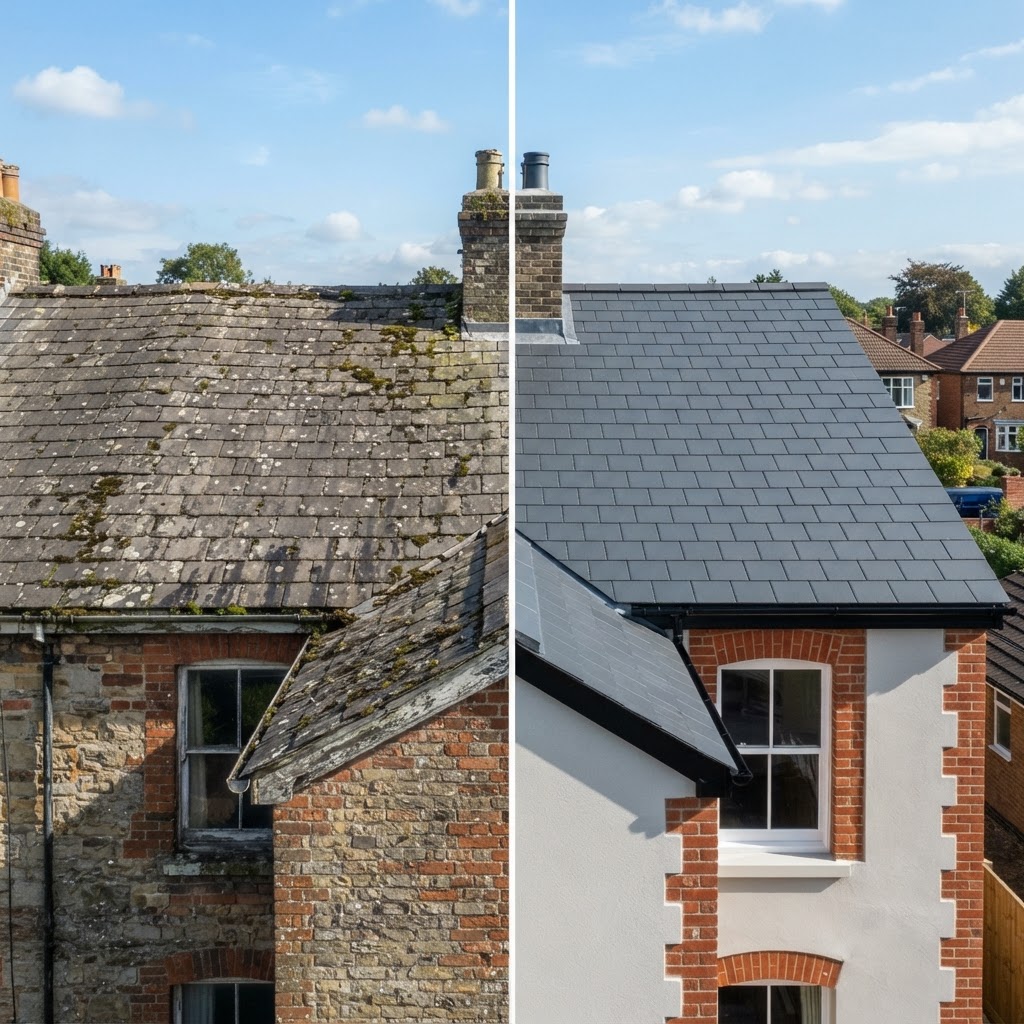
The repair path is cheaper in year one. But by year five or six, the cumulative repair costs often exceed what a replacement would have cost — and you still have an old, failing roof. That is the false economy of repeated repairs on a roof that needs replacing.
Lifespan Differences
A repair extends the life of a roof by months or a few years. A replacement gives you a fresh start with a full lifespan ahead. The lifespan you get depends on the material:
- Concrete interlocking tiles: 40 to 50 years
- Clay plain tiles: 60 to 80 years or more
- Natural slate: 80 to 100+ years
- Man-made (fibre cement) slate: 40 to 50 years
- EPDM flat roofing: 30 to 50 years
- GRP fibreglass: 25 to 35 years
- Torch-on felt: 15 to 25 years
A repaired roof has the lifespan of the original covering, minus the years it has already served. A new roof starts the clock fresh. If your current roof is 35 years old and made of concrete tiles rated for 50 years, a repair might buy you 5 to 10 more years. A replacement gives you another 40 to 50.
Making the Decision with a Roofer
The right way to make this decision is with a roofer who will give you an honest assessment — not a salesperson pushing for a replacement. A good roofer will tell you if a repair is sufficient, even if it means less work for them. We do this regularly: we inspect a roof, find that it has plenty of life left, and recommend a targeted repair instead of a full re-roof.
When you get an assessment, ask direct questions: How much life does this roof have left? Is the problem localised or widespread? What will the repair cost, and how long will it last? What would a full replacement cost? Is there any risk to the structure if I delay? A roofer who answers these clearly is giving you the information you need to decide.
We offer free roof inspections across Worcester, Pershore, Evesham, Bromsgrove, Redditch, Kidderminster and everywhere in between. We will tell you straight whether you need a repair or a replacement — and if a repair will do, that is what we will recommend. Get in touch to book a survey.
Summary
The repair-vs-replace decision comes down to whether the problem is localised or systemic. A localised problem — one leak, a few slipped tiles, a flashing failure — is a repair job. A systemic problem — widespread tile failure, perished underlay, recurring leaks, an aging roof — is a replacement job. The false economy is spending on repeated repairs for a roof that needs replacing, because the cumulative cost often exceeds the replacement price and you still end up with an old roof.
If you are unsure, the answer is simple: get a proper inspection. A roofer who knows what they are looking at will tell you honestly which side of the line your roof falls on. Call us on 01905 349450 or book a free survey — we cover all of Worcestershire.
Related resources
FAQ
Frequently asked questions
Is it better to repair or replace a roof?+
It depends on whether the problem is localised or systemic. A single leak or a few slipped tiles is a repair job. Widespread tile failure, perished underlay, recurring leaks or a roof past its lifespan all point to replacement. An inspection is the only way to know for certain.
When is a roof repair no longer worth it?+
A repair stops being worth it when problems keep recurring in different areas, when tiles are slipping because the nails are failing across the roof, when the underlay is perished, or when the roof covering has reached the end of its expected lifespan. At that point, repeated repairs cost more over time than a replacement.
How do I decide between repair and replacement?+
Get a proper roof inspection. A roofer will assess the tiles, underlay, timbers and flashings, and tell you whether the problem is localised or widespread. Ask how much life the roof has left, what the repair will cost and how long it will last, and what a replacement would cost.
What is the cost difference between repairing and replacing a roof?+
A typical repair costs £150 to £600. A full replacement on a semi-detached house costs £5,500 to £8,000. But if you are spending on repairs every year or two, the cumulative cost over several years can exceed the replacement price — and you still have an old roof.
How long does a repaired roof last compared to a new one?+
A repair might extend a roof by months to a few years, depending on the problem. A new roof gives you a full fresh lifespan: 40 to 50 years for concrete tiles, 60 to 80 for clay, and 80 to 100 or more for natural slate.
Can I just keep repairing an old roof indefinitely?+
You can, but it becomes false economy. As a roof ages, problems multiply and repairs become more frequent and more expensive. Eventually the underlay fails or the timbers rot, and at that point a full strip and re-roof is the only option — delayed repairs will not prevent it.
Not sure which way to go? Get honest advice from a Worcester roofer.
Call Sure Roofing Worcester for a free, no-obligation quote. Same-day response across Worcestershire.