Table of contents
- 01Missing or slipped tiles
- 02Water stains on ceilings
- 03Sagging roofline
- 04Cracked or crumbling mortar
- 05Daylight through the loft
- 06Moss and plant growth
- 07Age of the roof
- 08Recurring leaks
- 09Rising energy bills
- 10Neighbours replacing theirs
Roofs do not fail overnight. They give you warning signs — sometimes subtle, sometimes obvious — that the covering is reaching the end of its useful life. The problem is that most homeowners do not know what to look for, and by the time water is dripping through the ceiling, the damage is already done.
This guide walks through the 10 clearest signs that your roof may need replacing. If you spot one or two, it might be a localised repair. If you spot several, it is time to get a professional inspection before a small problem becomes an expensive one. We have seen every one of these signs on roofs across Worcester, Malvern, Droitwich, Pershore and the rest of Worcestershire.
Signs You Can Spot From the Ground
1. Missing or Slipped Tiles
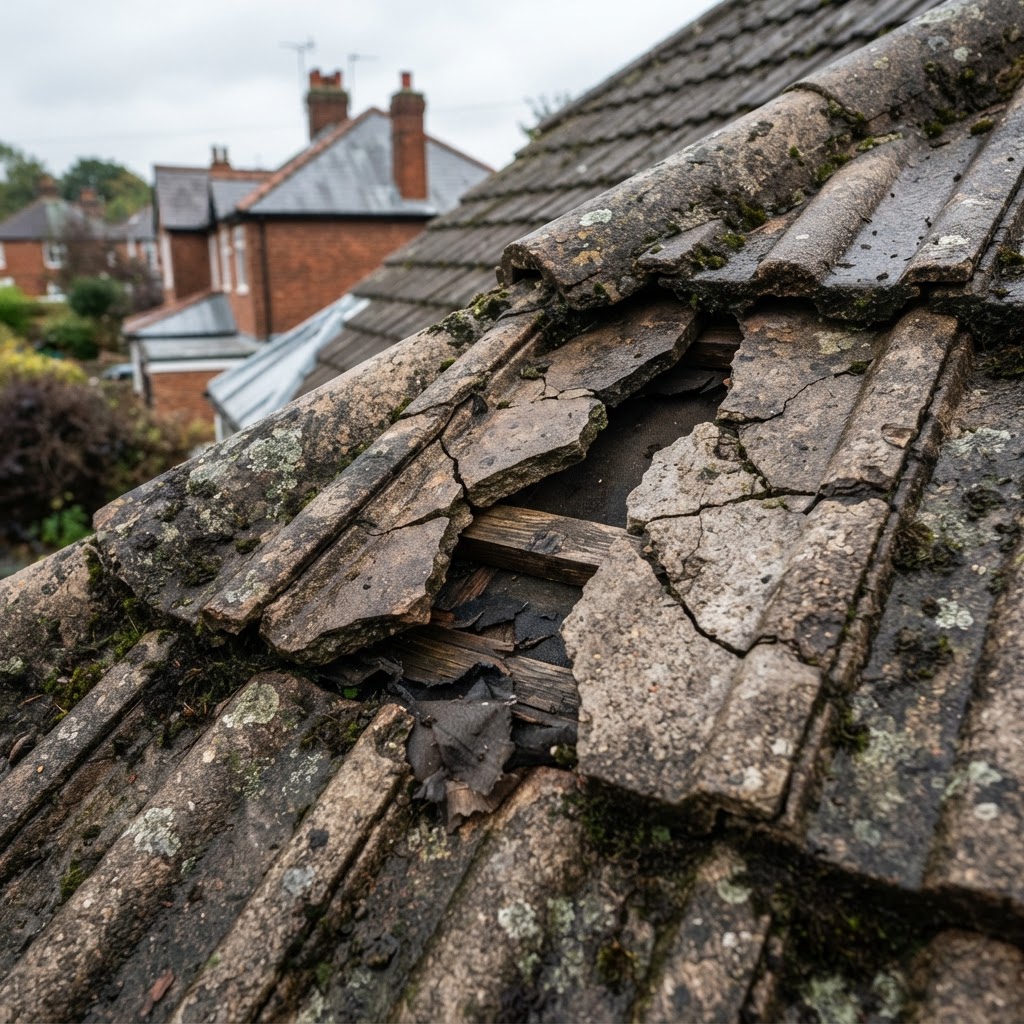
This is the most visible sign. If you can see gaps in the tile lines from the ground, tiles have slipped or broken away. One or two might be storm damage — a straightforward roof repair. But if tiles are slipping regularly in different areas, the nail fixings are corroding and failing. That is a whole-roof problem, not a local one.
2. Sagging Roofline
A roof should have straight, clean lines along the ridge and the verges. If the ridge dips, bows or sags, something is wrong underneath. It could be timber rot in the roof structure, failed purlins, or long-term weight stress from waterlogged tiles or multiple layers of roofing. A sagging roofline is not cosmetic — it is structural, and it needs urgent attention.
3. Cracked or Crumbling Mortar
Traditional roofs use mortar to bed ridge tiles, hip tiles and verges. Over time, mortar cracks, crumbles and washes away. If you can see gaps where ridge tiles meet, or mortar falling from the verges, water is getting in. Modern dry ridge systems and dry verge systems use mechanical fixings instead of mortar and do not have this problem — which is why building regulations now require them on new roofs.
4. Moss and Plant Growth
A little moss is common on older roofs, but heavy moss growth is a warning sign. Moss holds moisture against the tiles, which speeds up frost damage in winter — water freezes, expands, and cracks the tile surface. Moss also lifts tiles, breaking their weather seal. If your roof is thick with moss, the tiles underneath may already be spalling (flaking and crumbling). A maintenance clean helps, but if the tiles are already damaged, replacement may be needed.
Signs You Might Notice Inside Your Home
5. Water Stains on Ceilings
Brown or yellowish patches on your ceiling, or damp patches on the walls near the top of a room, mean water is getting through the roof. This is not a problem you can ignore. By the time water reaches the ceiling, it has already passed through the tiles, the underlay, and the timbers. The stain might look small, but the damage above it could be significant. Read our guide on what causes roof leaks to understand where the water is likely coming from.
6. Daylight Through the Loft
Go into your loft on a bright day, turn off any lights, and look up at the underside of the roof. If you can see daylight coming through gaps in the tiles or underlay, those gaps are letting water in too. A few pinholes of light might be acceptable on an older roof, but visible gaps — especially ones that correspond with water stains on the timbers — are a clear sign the roof covering is failing.
7. Recurring Leaks
If you have had a roofer out to fix a leak, and the same area (or a different area) starts leaking again within a year or two, the roof is telling you something. Recurring leaks mean the problem is not localised — the roof covering is failing across its area. At this point, repeated repairs become false economy. See our roof repair vs replacement guide for a detailed breakdown.
8. Rising Energy Bills
A failing roof does not just let water in — it lets heat out. If your loft insulation is getting damp from roof leaks, it loses its insulating properties. If gaps in the roof structure are allowing cold air in, your heating system works harder. A sudden or unexplained rise in heating bills, combined with any of the other signs on this list, could point to a roof that is no longer doing its job.
Signs That Relate to Age and Context
9. Age of the Roof
Roof coverings have expected lifespans. Concrete interlocking tiles last 40 to 50 years. Clay plain tiles last 60 to 80 years. Natural slate lasts 80 to 100 years or more. Torch-on felt flat roofs last 15 to 25 years. If you know your roof is past or near these ages, problems are likely — even if you cannot see them yet. Check our guide on how long a roof lasts for a full breakdown by material.
If you do not know the age of your roof, a roofer can estimate it from the type of tile, the style of fixing, and the condition of the underlay. Most Worcester houses built in the 1970s and 1980s with concrete interlocking tiles are now in the window where replacement starts to become a consideration.
10. Neighbours Replacing Theirs
This might sound like an odd sign, but it is surprisingly reliable. If your house was built at the same time as your neighbours, with the same materials by the same developer, their roofs are aging at the same rate as yours. If several neighbours on your street have had their roofs replaced in the last few years, yours is likely at the same stage. This is particularly relevant on the post-war and 1970s estates across Worcester, Droitwich and Malvern.
What to Do If You Spot These Signs
Spotting one sign does not automatically mean you need a new roof. A single slipped tile is a quick repair. But if you notice three or four of these signs together, the chances are that your roof is reaching the end of its life and a replacement is on the horizon.
The right next step is a professional inspection. A roofer will get up on the roof, check the tiles, underlay and timbers, and give you an honest assessment of how much life the roof has left. They will tell you whether a repair will do the job or whether a full replacement is the better spend. And if the answer is replacement, you will know the cost involved before you commit.
Do not wait for a ceiling to collapse or a storm to tear tiles off. If you have spotted any of these signs, book a free inspection or call us on 01905 349450. We cover all of Worcester and Worcestershire.
Summary
The 10 signs — missing tiles, sagging roofline, cracked mortar, moss growth, ceiling stains, daylight in the loft, recurring leaks, rising bills, roof age, and neighbours replacing theirs — are the clearest indicators that your roof may need attention. One or two signs might mean a repair. Several signs together usually mean replacement is approaching. The only way to know for sure is a proper inspection, and catching it early is always cheaper than waiting for a crisis.
Related resources
FAQ
Frequently asked questions
What are the signs I need a new roof?+
The clearest signs are missing or slipping tiles, a sagging roofline, cracked or crumbling mortar, water stains on ceilings, daylight visible through the loft, recurring leaks, heavy moss growth, rising energy bills, and a roof that is past its expected lifespan. If you notice several of these together, replacement is likely needed.
How do I check my roof condition myself?+
You can spot visible signs from the ground — missing tiles, sagging lines, moss growth. Inside, check the loft for daylight gaps and water stains on timbers, and check ceilings for damp patches. But a full assessment needs a roofer to get up on the roof and check the tiles, underlay and timbers properly.
Can repairs fix these signs?+
If the problem is localised — a few slipped tiles or one flashing failure — yes, a repair will fix it. But if the signs are widespread (tiles slipping across the roof, multiple leaks, perished underlay), repairs are a temporary fix and replacement is the proper solution.
How urgent is roof replacement if I see these signs?+
It depends on the severity. A sagging roofline or active leaks are urgent — water damage to timbers and ceilings gets worse quickly. Missing tiles or cracked mortar are less urgent but should not be left for months. An inspection will tell you how quickly you need to act.
Should I get a roof inspection even if I have no leaks?+
Yes, especially if your roof is over 20 years old. Many roof problems develop silently — perished underlay, corroding nails, early timber rot — and only become visible when they cause a leak. A inspection catches these early, when a repair might still be sufficient.
How many of these signs mean I definitely need a new roof?+
There is no fixed number, but as a rule of thumb: one or two signs may mean a repair is enough. Three or more signs, especially if they include recurring leaks, widespread tile slippage or a sagging roofline, usually mean replacement is the right call. A roofer will confirm.
Spotted any of these signs? Book a free Worcester roof inspection.
Call Sure Roofing Worcester for a free, no-obligation quote. Same-day response across Worcestershire.